Warm Up With God to Start the Day

Birds Greeting the Sunrise

The picture above shows birds sitting together in the river birch tree in our backyard. This is an everyday sight during winter, as they wait patiently for the sun to come up over the tall pines on the horizon. When the sunshine hits them, they sit still and puff themselves up to expose as much of their body to the warmth as possible. It looks like they want to absorb all they can to warm up after the cold night, and get ready for the day.

Some of the birds stay longer than others, but one by one, they apparently decide they’re ready, and fly down to the feeders or make the flight to the woods to start their day.

It makes me think of our need to warm up and get ready for the day. I’m not referring to temperature, though. I’m writing of our need to start the day by getting close to our Lord and letting Him warm us.

Like the birds, some of us may be able to spend more time doing that than others. I know some who get up early to make sure they have the time before things get busy. Or perhaps some have other activities that they are able to combine with time with God (something that doesn’t interfere with the communication). I’ve heard of others who get through the early morning rush and then grab a cup of coffee and  sit down for Bible Study and prayer.

There are many different ways we can get close to God and prepare for the day. I encourage us all to choose whatever time and method works best for us, and follow the birds example and take a few minutes to bask in His warmth.

Let the morning bring me word of Your unfailing love, for I have put my trust in You. Show me the way I should go, for to You I lift up my soul. Psalms 143:8 NIV

Do you have a way you get close to God to start the day?

Lover’s Leap for Joy?

Lover's Leap

Lovers' Leap Image by aeu04117 via Flickr

In this country’s mountainous regions there are many locations dubbed “Lovers’ Leap”. They all have associated legends, many involving Native Americans, and with variations on the “Romeo and Juliet” theme. (Perhaps there is a Lovers’ Leap legend in Great Britain and that’s where Shakespeare got the idea.) One legend in the Blue Ridge Mountains of Virginia has a white settler and the Chief’s daughter falling in love. After much scorn and exclusion from both families, the couple embraced and plummeted to their death to be together forever. Another location has a closer sequence to “Romeo and Juliet” – the two lovers were from different tribes, and members of the maiden’s tribe attacked the brave and left him for dead at the top of a cliff. The maiden found him, and thinking he was dead, she jumped off. When he awoke and discovered what had happened, he threw himself over to be with her.

Jesus’ refers to a different type of Lover’s Leap in the sixth chapter of the Book of Luke:

“Blessed are you when people hate you and when they exclude you and revile you and spurn your name as evil, on account of the Son of Man! Rejoice in that day, and leap for joy, for behold, your reward is great in heaven; for so their fathers did to the prophets.” Luke 6:22-23 ESV.

The reactions Jesus describes are also those associated with the Lovers’ Leap legends: scorn, exclusion, and hatred. The legends end in tragedy, yet Jesus tells us instead of jumping off a cliff, we should respond with a leap for joy.

That is humanly hard to grasp. We can understand the leap for joy made by those who had been physically crippled their whole life and were miraculously healed by Jesus (and Peter and Paul). However, in this passage, Jesus says we are blessed if we’re treated like the ill-fated lovers of the legends. That doesn’t sound like a miracle – or does it?

The critical phrase in Jesus’ statement is the requirement that our suffering be “on account of the Son of Man”. As the Apostle Peter wrote, “what glory is it” if we’re hated and scorned because we’re hateful and scornful ourselves? No, our enduring this type of suffering is “acceptable to God” and we can leap for joy only because of whom we love: Jesus Christ.

And what’s the miracle behind this lover’s leap for joy?

We love Him, because He first loved us.” 1 John 4:19

******************************************************************************

This post is part of the Christian Writers blog chain. Our theme for this month is “Leap”. Please see the list to the right and visit my friends’ blogs to see what they have to say about this topic.

As Charlene Darling Said, Songs Can Make Us Cry

English: it is picture of the sheet of the son...

Image via Wikipedia

Many years ago, I attempted song writing. None was worthy of publishing and most have mercifully faded from memory. However, there are two I remember (at least the titles). One was a soulful ballad about commitment, titled: “If I Don’t Leave, Then I Guess I’ll Stay”. The other was a heart-tugging song about unrequited love: “I Did a Belly-Buster in the Swimming Pool of Love”. (Charlene Darling of the old “Andy Griffith Show” would have certainly lamented “Don’t play that one, Pa, it always makes me cry!”)

Several years after those, when our son, Daniel, was still a baby, I made this one up to sing as I tried to get him to sleep (sung to any baby melody you choose):

“All the little gophers in gopher town, they all get together when the sun goes down.

They build a little fire, and dance round and round, all the little gophers in go..pher..town!”

Still probably not worthy of publishing, but I was pleased with the imagery, and Daniel seemed to enjoy it.

It’s difficult to write a good song, especially considering you need to have lyrics and an appropriate melody to go with them. It seems impossible to write a great one. That is one of the reasons so many hymns, old and new, are amazing. The words touch our hearts with their praise for our great and gracious God, pictures of unshakeable faith, and prayers for God’s continuing help. Their accompanying music, whether soaring and broad or simple and quiet, fits perfectly to complement the message.

The background of some of these songs makes them even more amazing: From the well known story of H. G. Spafford writing “It Is Well” on an ocean liner after it passed the spot where his four daughters had recently drowned, to the lesser known circumstances behind Thomas A. Dorsey writing “Precious Lord” after hearing his wife had died in childbirth and the baby had not survived, or “Tis so Sweet to Trust in Jesus” being written by Louisa Stead after her husband drowned trying to save a young boy.

These stories reveal the unshakeable faith of the composers. However, above that, especially when considered with the lyrics of the songs themselves, they reveal the love, mercy, and grace of our God.

All the little gophers in gopher town don’t really get together and dance around the fire after sundown (at least I don’t think they do). But, the Lord’s love, mercy and grace is real. It’s shown clearly when we hear that whether we’re in peace like a river, or in sorrows like a stormy sea, God makes us able to say: “It is well with my soul”; or, we cry out to the Lord to take our hand because we’re tired, weary and worn; or we affirm that it truly is sweet to trust in Jesus and know He is with us to the end. And, when God takes the song and reinforces that reality in our heart at just the right moment and for just the right reason, it can make us cry.

Windspinners and the Holy Spirit

Windspinner 2

Windspinner 1

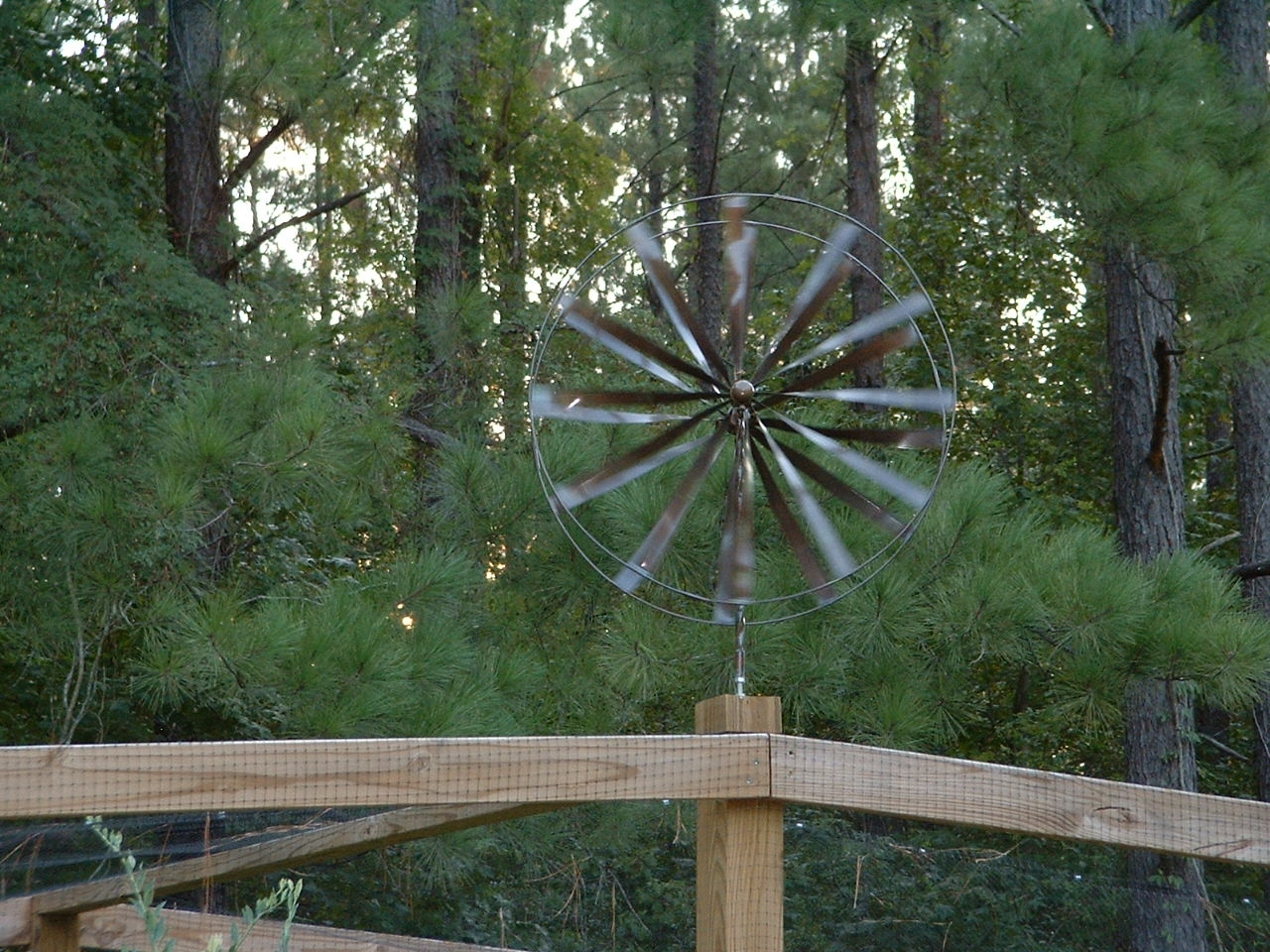
My wife, Sharon, gave me a windspinner for Christmas. Rather than calling it “the big one on the back of the blueberry netting frame”, I’ll refer to it as Windspinner 2 (WS2), and the original one on the front will be Windspinner 1 (WS1).

Windspinner 2 looks like a piece of art with its wide, curved vanes. Windspinner 1 has long, straight vanes, and reacts much like a propeller. With that shape, WS 1 only needs a slight breeze to set it in motion. A brisk wind spins it into a blur and you can’t distinguish the individual vanes (As info, the wheels are set to turn in opposite directions.)

WS 2 barely reacts to a light breeze. One wheel may rock back and forth, as if it’s considering spinning but unwilling to commit. It takes a strong, consistent wind to overcome the inertia and then keep it in motion. It doesn’t spin to a blur like WS1, and because of that, the curved vanes crisscrossing each other make a pulsating pattern that looks almost alive.

In John 3:8, Jesus likens the work of the Holy Spirit to the wind. We can perceive the effects of the wind but don’t know where it comes from or where it goes. These two gadgets reveal the effects of the wind differently – much as individual people reveal the effects of the Holy Spirit differently. Some react quickly, while others need a push and then slowly pick up speed.

That’s not meant to imply the Holy Spirit has to try different methods on a person until He finds one that is successful. The Holy Spirit is God, and when He has changed someone’s heart, He has perfect wisdom to know exactly how to turn, guide and help that person become what God wants them to be.

Perhaps someday I’ll post videos of the windspinners so you can see them in action. Until then, observe the various effects of the wind on the world around you. And, more than that, marvel as you see the Holy Spirit working in different individual’s lives, and praise God for the continuing miracle of saved souls.

“The wind blows where it wishes, and you hear its sound, but you do not know where it comes from or where it goes. So it is with everyone who is born of the Spirit.” John 3:8 ESV