Connecting With God

birds on a wire

birds on a wire (Photo credit: Vurnman)

As I drove past the interchange on I-16, I noticed a flock of pigeons perched on the power line. I didn’t count them but guessed there were 30 or more lined up on the wire, just sitting there waiting for something to happen – maybe hoping for a truckload of corn to be accidentally spilled along the highway (“Bob, do you remember the big corn spill of ’07? Boy, what a feast!”).

Or perhaps they were just talking among themselves, passing the afternoon away until it was time to go home to roost. (“Well, I think I’ll go home, take a little nap, then go over to Thelma Lou’s and watch a little TV”)

The next day my schedule took me back in that direction and they were in the same place. Since I didn’t pay enough attention to recognize any individuals from the day before, I wasn’t sure it was the same group – but I assumed it was. I wondered if they were lined up in the same order as the previous day, like us church-goers who sit in the same location in the pews each week. (“Hey! Move over – that’s my spot!”)

I’m not an expert on pigeon perception but I doubt they noticed me at all. (“Hey Joe, isn’t that the same red pickup that came by yesterday?”)

The pigeons and I didn’t make a connection. I was passing by and happened to see them for an instant. After those few odd thoughts, my brain turned to whatever I was thinking before. They were in their own little world, which didn’t include the people passing by on the interstate.

But some people do make connections with pigeons. The owners of homing pigeons easily recognize individual birds. They know each bird’s peculiarities in flight and pickiness in eating. In a race, the owner knows which one will get back first, and which one will lag behind the others. The connection is made because someone cares enough to invest their time and effort to make it happen.

I’ll agree most people won’t feel a desire to make connections with pigeons. I may notice them the next time I travel I-16, but I doubt I’ll get off the interstate to go introduce myself.

But there is a connection we need to invest time and effort to strengthen – our connection with God. In these busy days, it’s too easy to keep trucking down the road, giving only an occasional glance or thought in His direction and then moving on. So let’s stop awhile and sit and talk…or maybe like the pigeons, just sit.

Be still and know that I am God.” Psalm 46:10

The Lord Will Answer Those Who Thirst

Hanging Basket Closeup

Here’s a close up shot Sharon took several weeks ago of the hanging basket on the back porch. That was before the weather got really hot, and it’s struggling these days. I don’t seem to be able to give it all the water it needs.

When the poor and needy seek water, and there is none, and their tongue is parched with thirst, I the LORD will answer them; I the God of Israel will not forsake them.” Isaiah 41:17 ESV

Bean Poles and Helping Others in the Wilderness

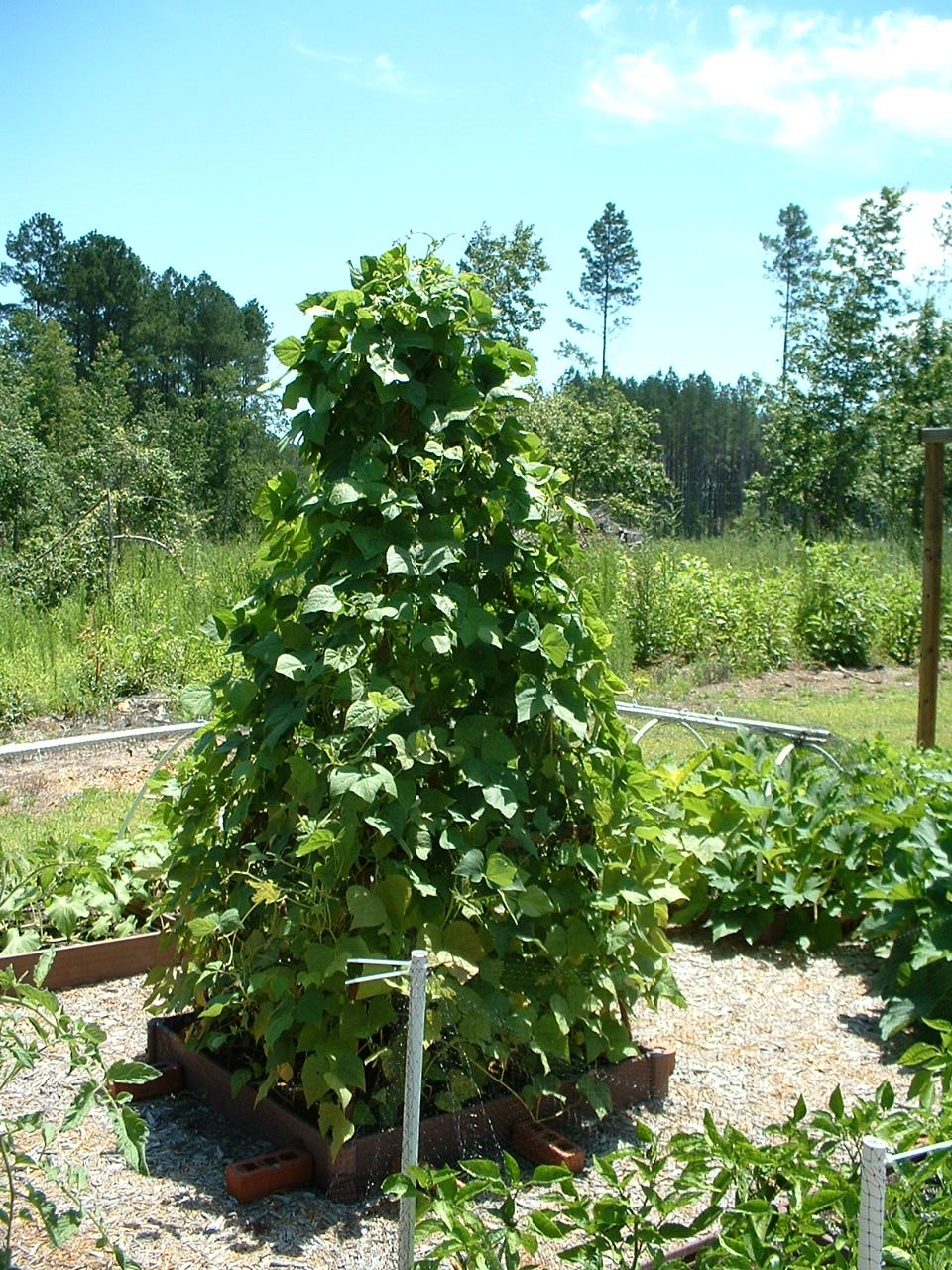
Bean Pole

Here is my first ever bean pole structure. I never got around to it until this year. I saw several fancy ones in catalogs but finally settled on getting some 1 x 2’s and attaching them to a top piece. I used bird netting around the bottom third to give the vines a place to start.

The structure worked out great, and the plants did well. I did learn that I let the beans go longer than I should have. They ended up being pulpy and a little stringy – I’ll pick them sooner next year.

Next, I’ll be looking for something to plant on it for the fall (any ideas?).

“(They) brought beds, basins and earthen vessels, wheat, barley, flour, parched grain, beans and lentils, honey and curds and sheep and cheese from the herd, for David and the people with him to eat, for they said, “The people are hungry and weary and thirsty in the wilderness.”” 2 Samuel 17:28-29

This passage occurs when King David and his followers are running from his son, Absalom, who started a rebellion against him. Those who saw their need, brought food and utensils to help them in their trial. Perhaps we can find someone who has a need in their wilderness, and help them (even something as simple as beans may be just the thing in some cases).

The Path of No Regrets

US Navy 050709-N-0000X-001 Satellite image tak...

US Navy satellite image of Hurricane (Photo credit: Wikipedia)

Tropical Storm Debby passed close enough to our area this week to be a reminder that hurricane season is here. It was interesting that early in the process the various computer-forecasting models didn’t agree. Some predicted the storm would head west to Texas, some said it would hit Florida, and one had it wobbling around in a loop in the northern Gulf of Mexico.

That reminded me of a television show about hurricane forecasting. In one segment, a forecaster described the process of recommending when, where and to what level to have coastal evacuations when a hurricane approaches. The uncertainty of the path (especially if the models disagree), and varying strength of the storm several days out, can make it difficult to determine what to do. Waiting too long may not leave enough time for the people to leave and can be disastrous. It can have that same result if a weak storm suddenly jumps up a couple of categories in strength just before it hits land.

Calling for an evacuation only to have the hurricane go elsewhere or fizzle out makes for unnecessary disruption, costs money and leaves many frustrated and angry people. It also increases the tendency to disregard the next call for evacuation – which may be the storm that does hit at full force.

With all that variability, what did he say they strive for?

“We want to take the path of least regret.”

That sounds like no matter which choice they make there will be some regret. Even if an evacuation is called and the storm hits as predicted, there are probably still some thoughts that it should have been a smaller (or larger) evacuation. On the other side, it’s clear that not calling an evacuation and having a strong storm hit an area is the worst possible outcome with much regret.

As Christians, we also make choices on the paths we take. Hopefully, we don’t use the “least regret” philosophy, but strive to follow God’s path for our lives. (“Show me your ways, O Lord; Teach me your paths.” Psalms 25:4 NKJV).

That doesn’t mean God’s path for us will always be straight and easy. In some ways, it may be harder than taking our own path – but choosing our own path is guaranteed to have regrets.

The Lord speaks in a wonderful assurance verse in Isaiah that relates to the paths we follow:

I will bring the blind by a way they did not know; I will lead them in paths they have not known. I will make darkness light before them, And crooked places straight. These things I will do for them, And not forsake them.” Isaiah 42:16 NKJV.

God’s paths can make us struggle at times – and sometimes they’re meant to. We may blindly struggle in the darkness (remembering we all were once spiritually blind and in darkness) but as we trust in God, the light becomes clearer. As we follow Him where we’ve never been, we notice the crooked ways straightening out. And, as we reach the end of a journey and look back, while we may have some regrets of our own missteps, we can see God’s faithfulness. He has truly done what He said and has not forsaken us. Then we can praise His Name, and declare “Thank you, Lord. I have no regrets for following You!”